Update from Massachusetts Family Institute on Massachusetts Senate Bill 70 (The Counseling Ban)
Updated April 9th, 2019
MA Senate Bill 70 violates freedom of speech, parental rights and religious freedom
SEE YOU IN COURT! Massachusetts Governor Charlie Baker signed the Counseling Ban last night, April 9th, 2019.
Massachusetts Family Institute is already hearing from potential PLAINTIFFS and is prepared to help them protect their rights in court.
PLEASE CALL or TEXT my cell phone at (978) 204-9131 if you know a minor (age 17 or younger) and parents that want therapy to escape LGBTQ lifestyle OR a Licensed Therapist that desires to give such therapy.
The only way now to protect free speech and access to therapy is through the courts. We NEED your help!
Read more about current LGBTQ activist plan to continue to assault religion and family values here: https://tapit.us/lYiuO Please SHARE with EVERYONE YOU KNOW!Michael King www.mafamily.org
(978) 204-9131 (cell)
UPDATE Friday 3/29/19: Unfortunately, Senate Bill 70 passed on Thursday March 28th, 2019 with a vote of 34-0. But I urge you to read this post if you have not already so you can be informed and know what next steps to take to try to stop this threat to freedom of speech, parental rights, freedom of religion and the safety and well being of children. Massachusetts Family institute is urging residents to call Governor Charlie Baker at Phone: (617) 725-4005 NOW and ask him to veto the bill which is set for signing early next week.His office staff informed me today that you may leave a message voicing your concerns after hours and your request will be tallied. *I added more information on the results of the vote and some of my thoughts on them at the end of this article. (A strike-through indicates that information has been updated.)
The Massachusetts Senate will votevoted on Senate Bill, SB. 70, (the Counseling Ban), this Thursday, March 28th at the State House. If this bill goes into law it will violate freedom of speech, religious freedom, and the rights of parents to raise their children according to their moral and religious convictions. This bill would force counselors and parents to go against their beliefs about human sexuality and violates rights to privacy of patients and counselors.
Some think this bill will not affect them as they aren’t facing the situations it addresses. But regardless of where your convictions fall on gender identity and sexual orientation, and whatever your religious persuasion, bills like SB. 70 endanger the freedoms of all. Other states have also been pushing similar bills.
HB. 140/ SB. 70 would make it illegal for licensed health care professionals to offer counselling or talk therapy that encouraged a gender-confused minor to feel comfortable as the biological sex they were born, or to change, suppress, or stop any behavior or feelings in regards to their opposite-sex gender identity or sexual attraction toward others of the same sex. But they would be legally required to promote hormone therapy and sex-change surgery. This applies even if the minor is the one seeking help to change sexual attractions or behavior they don’t want to continue.
Parents who opt for counseling the state doesn’t sanction for their gender-confused child rather than cross-sex hormones or surgery, would be subject to DCF intervention which could result in the child being taken from their home and then receiving sex-change treatments without parental consent.
This bill mis-labels certain counsel as child abuse and dictates and limits healthcare workers in the diagnosis and treatment of their patients. Prohibiting licensed counselors from guiding those who seek help with their struggles by freely discussing and exploring a patient’s symptoms and feelings is negligent medical practice and abuse. If one doubts a healthcare worker’s advice they can choose to get a second opinion.
Many who identify as one sexual orientation shift to another, or between several categories over time. They change their minds. So why the push to alter one’s body with hormones or surgery? What’s the rush? This is especially true for children who do not yet have the capacity to fully comprehend the choices and their long term ramifications.
If a child identifies as a dog should the parent allow them to undergo treatment to become like a dog?
If a child thinks he is Superman, is it abuse if their parent doesn’t allow him or her to leap from buildings with a single bound?
If a white child declares they are a black child trapped in a white body, or a black child identifies as a white child, should their parents be forced to let them undergo treatment to permanently change their skin color?
I have a dream that one day on the red hills of Georgia, the sons of former slaves and the sons of former slave owners will be able to sit down together at the table of brotherhood. ―Martin Luther King Jr.
The King of all creation, Jesus, shouldered our sin and calls us to bear one another’s burdens.
Bearone another’s burdens, and so fulfill the law of Christ. Galatians 6:2 (NKJV)
bearing with oneanother, and forgiving oneanother, if anyone has a complaint against another; even as Christ forgave you, so you also must do. Colossians 3:13 (NKJV)
So, why are we shouting?
But avoid irreverent, empty speech, for this will produce an even greater measure of godlessness. 2 Timothy 2:16 (HCSB)
..in the process of gaining our rightful place, we must not be guilty of wrongful deeds. We must forever conduct our struggle on the high plane of dignity and discipline. We must not allow our creative protest to degenerate into physical violence. Again and again we must rise to the majestic heights of meeting physical force with soul force. —Dr. Martin Luther King Jr., I Have a Dream, speech
“the time is always right to do the right thing”―Martin Luther King Jr.
A new commandment I give to you, that you love oneanother; as I have loved you, that you also love one another. John 13:34 (NKJV)
We are not our skin; it’s just the stuff we live in. Strawberry, lemon, chocolate, vanilla—let us savor the flavor in each other’s cultures.
Some believe themselves superior while exhibiting inferior behavior toward others. With large mouths, shriveled hearts and tiny mindsets they eke out finite lives in their effort to undermine noble ones. Others say they want equal rights but demand special privileges.
I have a dream that one day this nation will rise up and live out the true meaning of its creed: “We hold these truths to be self-evident, that all men are created equal.”―Dr. Martin Luther King Jr.
What if instead of looking out for ourselves we looked out for each other?
Let nothing be done through selfish ambition or conceit, but in lowliness of mind let each esteem others better than himself. Philippians 2:3 (NKJV)
The Bible says:
And He has made from one blood every nation of men to dwell on all the face of the earth, and has determined their preappointed times and the boundaries of their dwellings, Acts 17:26 (NKJV)
The Great Seal of the United States of America says we are. “E Pluribus unum, out of many, one.” Our pledge of allegiance states, “one nation under God, indivisible, with liberty and justice for all,” and our national motto says, “In God We Trust.” But when we seek our own and trust in man, as some do, we end up divided. See, the Gospel has the answers—it is the answer for all that ails us.
We are meant to marvel at the majesty of the Creator in His creation.
There is a root that sustains
There is one Vine—
Jesus
How marvelously He colors our lives with vibrant brushstrokes of many hues—
Facets of Himself reflected in our differences
Let us recognize our common ground
And celebrate
The ongoing work of the The Master Artist.
Portrait of Martin Luther King Jr. by Jean Colby
Link here to read: One Blood, A Civil Rights Story, as told to me by Jean Colby, my mother-in-law and Sara Clay, my sister-in-law about their experiences as Civil Rights activists, about the March Against Fear, MLK, and James Meredith. (Scroll down in my post, See, Stand, Speak.)
What are your thoughts on the current racial tensions in America? What do you feel has fueled them and what do you think we as a nation and the Church can do to quell this and bridge the racial divide?
…The tensions are high and so political. The whole thing upsets me. People’s lives should never ever be political playing cards, and yet they are. They always are. I believe that what we did during the time of slavery was horrifying and we should not be dismissive of those whom it is still impacting today. I believe…
…My wife is Chicana from west Texas, and I, (though Texan as well), am actually a fifth generation Cherokee that left the… Click here to Continue.
The onset of the year is a good time to acknowledge the challenges we face, the changes needed, and to look to Jesus through whom we are more than conquerors. The last two articles in my 2018 series of interviews with pastors and pastor’s wives—have bled over into 2019. So, please, grab your favorite hot cup of comfort, pull up a chair, and let us listen to the words of wisdom offered by these mighty ministers.
How do you feel about the spiritual and cultural climate where you are pastoring?
Pastor Kevin Obermeyer:I think there is a huge spiritual battle going on, and Christians are losing ground rapidly.
Pastor’s Wife, Janet Foley: I feel like the Gospel is often misunderstood and disrespected. I feel a bit intimidated here to share the gospel, more than other places. There is a lot of witchcraft, new age religion and political correctness here. A lot of ex-Christians, a lot of drugs too. Pot has been legal here for a few years so many people are hooked on it as well as methamphetamine. There’s also a lot of spouse-swapping, (married people who exchange for fun), which really freaks me out. Ugh.
Pastor Pablo Catala:I think it has been diluted and stained with perversion and sin unimaginable.
Pastor’s wife, Sophie Foley: It’s a breath of fresh air where we are pioneering. This is such a culturally diverse area, that most people have either not been exposed to Christ and so have no formed opinions and are open. Others have been raised with a respect for church so they are receptive and respectful of both the church and the role of the pastor.
What do you see as the biggest threat to the church today?
Anonymous Pastor, Kathmandu, Nepal: Complacency.
Pastor Tim Schmoyer:Consumerism is the biggest threat. Seeing church involvement as one of the many choices in the buffet of life.
Janet Foley:Political correctness, compromise, complacency. Too much activity without true relationship with Jesus.
Sophie Foley:Emotional indulgence. People are so very fragile now, and when it comes time to speak a bit of caution or direction, the confrontation of it is no longer acceptable and they leave for churches that never confront.
Also, media. We are a generation so connected to our devices, and yet we are steeped with loneliness and depression, which causes us to withdraw and avoid dealing with the social interaction of church services. We have several people who want to come but are easily distracted, or too emotionally distraught, so they stay home and binge movies, and then feel terrible and it becomes a vicious cycle.
“Hi Pastor Obermeyer. Would you like to unwrap these statements of yours a bit, which you gave in answer to my questions? Here, Preacher; the floor, or rather, the pulpit is yours! If you wish to take it—go!”
“Okay, rolling up my sleeves, lol.”
Rachael: What most breaks your heart? What do you see as the biggest threat to the church today?
Pastor Kevin Obermeyer: The condition of the church these days, which gets so caught up with the world and then wonders why it isn’t being effective. Secular worldviews, worldly attitudes, Biblical illiteracy, and ignorance.
What I mean is that I see many worldly philosophies and practices actively being taught in the church by ignorant and immature Christians. Spiritual immaturity is rampant, as is Biblical illiteracy. I hear more people offering their logic and opinions than actual Scripture verses. I hear Christians talk about “centering,” themselves, not realizing they are really talking about centering their “chi,” or life energy, which is a complete Eastern thought about how our life energy vibrates out of balance and needs to be re-centered.
Even yoga is designed for this, each position centering and balancing a different part of the chi; and yet we find “Christian yoga,” which is kind of a contradiction in terms, being led in some churches. I hear Christians talk about karma—good and bad karma and how karma is going to, “get that person.” This is horrible. Karma is not the same thing as the Biblical teaching of reaping what you sow despite its popular use even among Christians. Karma is a cosmic force, energy, or presence generated by the sum of a person’s actions, good and bad, which affects the nature of a person’s existence and determines their destiny or fate through transmigration into their next incarnation. That’s a mouthful, but it’s even more than that. It’s also one of the three margas, or paths to Brahman or salvation taught in Hinduism, being the path through works.
All of this comes from paganism and mythology and is completely contrary to Scripture, which teaches against reincarnation and salvation by works. It also puts our trust for justice and vengeance in something besides a merciful God and bypasses mercy altogether. Sadly, so many people today think they get into Heaven by doing enough good things to outweigh the bad, which is why many people struggle with the security of their own salvation in Christ.
As it is written: “Thereisnone righteous, no, notone; Romans 3:10 (NKJV)
For by grace you have been saved through faith, and that notof yourselves; it is the giftofGod, not of works, lest anyone should boast.Ephesians 2:8-9 (NKJV)
Karma completely undermines the finished work of Christ on the cross and the hope we have in Him. It puts all the responsibility on us and our own abilities to save ourselves, which is an impossible task. And it isn’t enough just to say you don’t use the word, karma, that way but mean something else, like good or bad luck, (also pagan). The Bible is clear that it is what it is regardless of how you use it (c.f 1 Corinthians 10:19-21). And if that isn’t clear enough, Paul specifically writes that we are to avoid even the appearance of evil (1 Thessalonians 5:22). The Bible is replete with passages, (Old and New Testament), telling God’s people not to be like the pagans and not to do what they do, especially in dance, worship, and lifestyle. We are to be different, set apart, holy. That’s something I think a lot of Christians overlook but really should investigate. Both Paul and Christ warn even further against causing others to stumble in their faith by one’s own misleading actions.
People offer their thoughts and positive energy along with their prayers; again Eastern thought. And they confuse Eastern and New Age meditation, (emptying your mind and thoughts), with Biblical meditation, (filling your mind and thoughts with Scripture and Godly reflection). Christ warns that an empty “house” is vulnerable to being filled with demons, (Matthew 12:44-45). We think if we call it, “mindfulness,” then it’s not the same thing as Hinduism, Buddhism, and New Age thought; whatever you want to call it, it isn’t Biblical.
I see churches and pastors getting distracted and becoming more concerned about looks and feels and making sure people are entertained rather than about teaching solid truth and deep faith. We sure get fired up about political and social issues, and we’ve got to look fly in front of people to keep up with the world, while the meat of God’s Word for daily living, spiritual growth, furthering of God’s Kingdom, and changing that world can just take a backseat—as if we don’t truly believe in it’s Power. I hear more motivational speaking than preaching, and those are not the same thing. Sadly, the church is sick and is presenting a shallow Gospel, and then we wonder why so many people, especially young people, question and abandon their faith. They’ve been given a different Gospel (2 Corinthians 11:3-4; Galatians 1:6-9) with no saving power. Their need isn’t satisfied. Their faith doesn’t take root because their faith hasn’t been placed in the true Solid Rock of Christ, but sinking sand.
Rachael: If you could tell the Church anything, what would it be? What’s on your heart?
I recently had the privilege of being on an outreach team to help Pastor Pablo and Nicole Catala’s pioneer church in Bridgeport CT. I was struck by how laid down, how wide open and vulnerable their hearts and lives were for God and the people of their city. I watched them love people with the love of God. I watched the ease with which they outreached, their children alongside them—truly a team, like a machine in sync. I took note of their home. Everywhere I turned there were photographs of their family and decor that shouted in unison about God and family. I learned their story later and asked them to share it. Here it is.
The Catala Story
Nicole Catala: One night my husband and I were fighting and basically done with our marriage. We both never had an example. We were only 6 months married and wanted to go for a divorce! That night my husband packed his clothes and left the house. The very next day I got a flyer from someone that there was going to be a healing crusade right across the street in Poe Park, put on by Victory Chapel in the Bronx, NY. As I was looking at the state of my life I knew I needed a miracle. I didn’t want my life to be just like the life of my family: Divorced, having multiple children from different men. I decided to go to the first night of the healing crusade. I was in a state of depression at only 18 years old and felt there was no hope for me and my eight month old son. Continue reading “From Dope Dealer to Hope Dealer”
It is freedom of religion, America, not freedom from religion. Remember our foundation.
Congress shall make no law respecting an establishment of religion, or prohibiting the free exercise thereof; or abridging the freedom of speech, or of the press; or the right of the people peaceably to assemble, and to petition the Government for a redress of grievances.
Stand for our flag, the red, white and blue
The Bible is our foundation, tested and true
Remember the blood shed, our freedom to gain
Pray for God’s blessing on our great nation to rain
“And He has made from one blood every nation of men to dwell on all the face of the earth, and has determined their preappointed times and the boundaries of their dwellings,” Acts 17:26 (NKJV)
We hold these truths to be self-evident: that all men are created equal; that they are endowed by their Creator with certain unalienable rights; that among these are life, liberty, and the pursuit of happiness. —Thomas Jefferson
If My people who are called by My name will humble themselves, and pray and seek My face, and turn from their wicked ways, then I will hear from heaven, and will forgive their sin and heal their land.
PFC David Fosdick Taylor was only 19 when he and his fellow soldiers of the 104th Infantry Division “Timberwolves” of the United States Army fought to the north of where the Battle of the Bulge was waged. The cold, wet conditions in November and December 1944, made it all the more miserable and caused David and many of the men to suffer from trench foot.
Shots rang out as the Timberwolves pressed toward the Nazi army and enemy snipers fired at them from the trees. In the exchange of gunfire, a bullet found its target and an American soldier fell and lay wounded in the space between them and the enemy.
A volley of enemy ammunition rained down as David ran across the open field and carried his fellow soldier back toward their unit. A bullet ripped through David’s leg and he stumbled, but regained his footing and kept going.
David lay recovering from his wound in the 203rd General Hospital outside of Paris, grateful to be alive and to have saved the soldier’s life. But he longed for home. His thoughts drifted to his younger sister, Jean, and the sweet sound of her singing as she played Christmas carols on the family piano in the parlor. He picked up his pen and began to draw.
David received the Purple Heart awarded to servicemembers wounded or killed while engaged in battle with the enemy.
~~~*~~~
I wonder how many know that in 1999, congress designated May as Military Appreciation Month? Someone informed me that May fourth was Star Wars Day. But of the fifty people I asked, only two knew the third Saturday of May is designated as Armed Forces Day. It bothers me when heroes, those who serve, are overlooked, unheard, misunderstood, or not shown the appreciation and support they deserve.
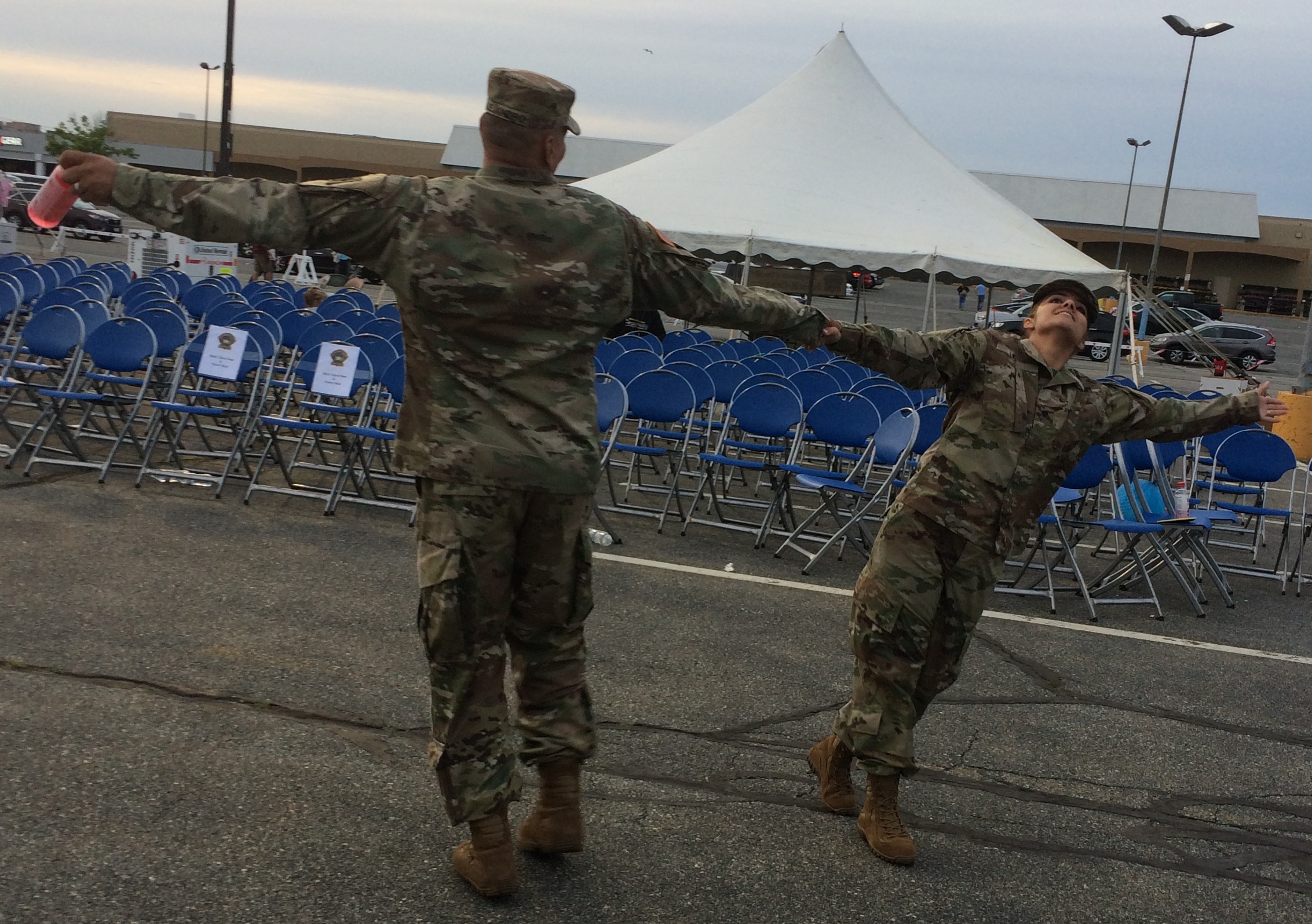
On a wind-whipped, drizzly late afternoon, I set out with notebook and pen to the annual Memorial Day weekend Troops in the Spotlight event across town. I’d hesitated to go, and wondered if they’d talk to me. Our troops protect and serve us in all kinds of adverse conditions, and the weather didn’t dampen their spirits. What a joyful privilege to interview our active duty and retired military members and share their words along with military history.
“I joined the military because I’m answering my calling,” said the first young United States Army serviceman I interviewed.
“The sacrifice of being away from my family is the hardest. The births, funerals, birthdays I miss. When my niece asked why I wasn’t at her birthday…when you come home, and kids don’t know you. It’s hard not being there for my family, but those people I’m not there for are the reason why I’m gone. I’m doing this for them, to take care of them. So, by being away, I am there for them,” he said.
Armed Forces Day
The National Security Act, signed into law on July 26, 1947[1], by President Harry S. Truman, unified the Army, Navy, Marines, and Airforce under the Department of Defense.
To signify this unification, “President Harry S. Truman led the effort to establish a single holiday for citizens to come together and thank our military members for their patriotic service in support of our country.
On August 31, 1949, Secretary of Defense Louis Johnson announced the creation of an Armed Forces Day to replace the observance of separate service days.[2]”—Department of Defense website[3]
The Army, Air Force and Navy adopted Armed Forces Day and last celebrated their individual service days in 1949. The Marine Core League supports Armed Forces Day and continues to celebrate Marine Core Day as well (November 10th). Likewise, the Coast Guard (under the authority of Homeland Security in peacetime, and the Navy in wartime) celebrates both Coast Guard Day (August 4th) and Armed Forces Day.
President Truman made the Presidential Proclamation of Armed Forces Day on Feb 27, 1950.[4] First celebrated on May 20, 1950, it is now observed on the third Saturday of May.
“I thought, why not be the first to serve in my family?”
“It’s stable. Good pay.” (Served in Kuwait twice)
“I was in a rut and in need of a way out. I felt the military was a good way out —[it offered] schooling, job.
“After college, I couldn’t find a job. My Father was an Army reservist and encouraged me. My Grandfather was a World War II Navy veteran.”—U.S. Air Force
“I joined because I wanted to do something better with myself.”—Retired, U.S. Air Force serviceman of 20 years
What bothers you?
“The hardest thing is being away from my family. I have friends serving overseas.”
“When I ask for the military discount, and they ask for my husband’s ID. I’m the service person.”
“Recognize women in the military. People ask about us being harassed in the military. I get harassed by those not in the military.”
“Staying up all night.”
“The PC. Why is there any such thing as politically correct?”
“I have lost two friends in combat.”
“Most American citizens aren’t aware servicemen died today in combat. Do they know their names?”
~~*~~
The History of Memorial Day
In 1866, a year after the Civil War ended, a women’s memorial association in Columbus, Mississippi, decorated the graves of Confederate and Union soldiers with flowers. This benevolent gesture inspired the poem “The Blue and the Gray,” by Francis Miles Finch. Perhaps these women’s reconciliatory actions influenced the creation of Memorial Day and its customs.
On May 15th, 1868, Union hero and Commander-in-Chief of the Grand Army of the Republic, Maj. Gen. John A. Logan, issued General Order Number 11, designating May 30 a day of memorial, originally known as Decoration Day, “for the purpose of strewing with flowers or otherwise decorating the graves of comrades who died in defense of their country during the late rebellion, and whose bodies now lie in almost every city, village, and hamlet churchyard in the land.”
With President Ulysses Grant presiding, General James A. Garfield (who became 20th President of the United States in 1881) spoke at the first national Memorial Day observance ceremony. This took place on May 30, 1868, at Arlington National Cemetery, the grounds of which were formerly the estate of Confederate General Robert E. Lee.
Memorial Day was later expanded to honor all deceased American military men and women who gave their lives defending our nation in battle. In 1971, federal law moved the observance of Memorial Day to the last Monday in May.
Today Memorial Day is observed at Arlington National Cemetery by decorating each grave with an American flag and placing a wreath on the Tomb of the Unknown Soldier. In other military cemeteries, flags are placed on the graves of all veterans and even on their spouse’s graves on Memorial Day.
General James A. Garfield’s Speech, known as “His finest hour,” given at the first national Memorial Day:
“I am oppressed with a sense of the impropriety of uttering words on this occasion. If silence is ever golden, it must be here beside the graves of fifteen thousand men, whose lives were more significant than speech, and whose death was a poem, the music of which can never be sung. With words we make promises, plight faith, praise virtue…”[5]Click to continue.
Canadian officer and surgeon Major John McCrae penned the famous wartime poem, In Flanders Fields in 1915 during WWI. It inspired the red poppy’s rise of popularity and subsequent adoption as a symbol of remembrance. By 1917, In Flanders Fields was known throughout the English-speaking world and used to bring attention to the war effort, recruit American soldiers, and help raise money for the troops. [6]
In Flanders Fields
-by John McCrae
In Flanders fields the poppies blow
Between the crosses, row on row,
That mark our place; and in the sky
The larks, still bravely singing, fly
Scarce heard amid the guns below.
We are the dead. Short days ago
We lived, felt dawn, saw sunset glow,
Loved, and were loved, and now we lie
In Flanders fields.
Take up our quarrel with the foe:
To you from failing hands we throw
The torch; be yours to hold it high.
If ye break faith with us who die
We shall not sleep, though poppies grow
In Flanders fields.
Do you have concerns about our military?
“No concerns. Everything is a cycle. What goes up will come down and what is down will come up.”
“Drill instructors aren’t tough enough today on recruits.”
“I’m concerned the military has gotten a little soft.”
“The definition of hazing has gone too far.”
“Now there is more paperwork. The military used to be more physical. You can’t engage the enemy with paper.”—U.S. Army
“We need to toughen up the military.”
“We hope they don’t shut down more bases. This is how we support our families. This is our job. This is who we are. This is what we do.”
“It is what it is. I don’t get caught up in the possibilities, the threats. I knew what I was getting into when I signed up.”—U.S. Air Force
“It’s horrible how people treat our police officers.”
“The way kids are being brought up. They don’t respect authority, and only want to play games. I think they should all serve two years in the military after high school.”
“Children today have no respect for authority.”
“People don’t have respect for authority, for each other, the military, our country.”
“We need more enlistments.”
“I’m concerned about the disconnect. Less than 1% of the population carry the burden of serving in our military.”—U.S. Army
“The situation in the nation between citizens, the youth, and police officers.”
“Taking away gun rights doesn’t stop the bad guys. We need rules and regulations. But you need the right to defend yourself.”
“Be aware. Isis is everywhere. They are here. Living on your street.”
“They, [American civilians], think Otis Air Force Base is closed. They don’t know there is still a war [on terror.]”—U.S. Air Force
~~*~~
War is a terrible thing, but sometimes it’s necessary to wage war to win peace and secure freedom. There is no neutral ground—we either advance good or enable evil.
Many are the sacrifices our military members make for their country and those they love.
Greater love has no one than this, that one lay down his life for his friends. (John 15:13 NASB)
I’d be remiss to not draw attention to the most epic battle ever waged—the war for our souls. Jesus fought to rescue us from the grip of our enemy Satan’s tyranny. We don’t have to live captive to our sin, sorrow, or past.
The greatest danger—that of the unredeemed soul precariously perched on the edge of hell is ever present, whether they’re aware of their jeopardy. A wise soldier wouldn’t step into battle unprepared. An even greater tragedy is to navigate life’s battles and step into eternity unprepared.
Jesus said, “He who has the Son has life; he who does not have the Son of God does not have life.” I John 5:12 (NKJV)
Why choose to remain a prisoner when love drove Jesus to give His life on the cross as ransom for our sin? He defeated the devil, conquered death, and hell when he rose, thus opened the way so we can walk free.
Therefore if the Son makes you free, you shall be free indeed. John 8:36 (NKJV)
~~*~~
How can American civilians support our military?
“Many Americans don’t understand our military. A gap exists between civilians and the military. People ask, most don’t know we [U.S. military forces], are still at war [in Iraq as part of the global war on terror.] In World War II, there was a shared sacrifice with civilians. They participated in the war effort to meet the needs. We need civilians to educate themselves and participate.”—U.S. Army
“Remember, we are serving. Serving here is just as important as serving overseas. We have jobs, we volunteer in the community, train personnel to deploy, help with school, with storm support, the Red Cross, the Boston marathon, communications.”—U.S. Air Force
“I never really thought about it; I get treated well. Show support—like at Troops in the Spotlight.”—U.S. Army
“We do our duty. Be supportive of the military. Some towns locally don’t show support for us. When they see us, it’s like, ‘What are you doing here?’ — I’d like to see more parades and events—to be more a part of the culture.”—U.S. Army
“I could say more benefits, or that some things need to be fixed with the VA, but what we really need is unity. Have your differences. You’re an immigrant. Welcome—but you are an American now. Be one nation.”—U.S. Army
“Be an American. Show your support, like you’re doing now. Appreciate the benefits of the U.S. being your home. Take care of it. America needs to come first. Just be a civilian and do the best you can.”—U.S. Air Force
“I’m concerned that we are divided. Realize what we as a nation are about: United—one nation.—Represent your flag. We need understanding, to accept, and respect each other. Out of many one people. Have your culture; have your heritage. Be proud of your heritage—but we are all Americans. E Pluribus Unum; out of many, one. We are Americans first.”—U.S. Army serviceman twice deployed to Afghanistan.
“Those citizens who are doing their best—we appreciate it.”—U.S. Army
~~~*~~~
The good soldier fights for freedom, righteousness, and securing an ordinary peaceful life and opportunity for their people. Those fulfilling wholesome occupations are part of a soldier’s reward they can look forward to coming home to. May we each do our duty in light of the trust we’ve received as citizens of our great nation. And if you are a Christian, also as soldiers and ambassadors for the gospel of Jesus Christ. No task is insignificant if it plays a part in fulfilling our call. What are you called to? Do that.
Link to video of: The Star Spangled Banner (with lyrics) Performed by Sandi Patti with the original lyrics written by Francis Scott Key in 1814 and added verse composed by Claire Cloninger for the Statue of Liberty Centennial Celebration in 1986.
To our American military personnel who served, to those who paid the ultimate price by laying down their lives for our freedom, and those who currently serve and protect in our United States Army, Navy, Air Force, Marines, Coast Guard, Space Force, and National Guard: Thank you.
May God help us raise our families, appreciate our freedoms, care for our countrymen and nation, and live our lives in such a manner worthy of the sacrifices of our men and women in uniform. I pray for God’s direction, protection, provision, strength, and blessings on them and their families. May our hearts hold our American military in grateful honor and prayer and demonstrate our love and support for them, not only on designated days, but always.
“In addition to the named wars and conflicts listed below, members of the American military (and some civilians) have played small but active roles in many other international conflicts.”
Dates
War in Which American Colonists orUnited States Citizens Officially Participated
Major Combatants
July 4, 1675 -August 12, 1676
King Philip’s War
New England Colonies vs. Wampanoag, Narragansett, and Nipmuck Indians
1689-1697
King William’s War
The English Colonies vs. France
1702-1713
Queen Anne’s War (War of Spanish Succession)
The English Colonies vs. France
1744-1748
King George’s War (War of Austrian Succession)
The French Colonies vs. Great Britain
1756-1763
French and Indian War(Seven Years War)
The French Colonies vs. Great Britain
1759-1761
Cherokee War
English Colonists vs. Cherokee Indians
1775-1783
American Revolution
English Colonists vs. Great Britain
1798-1800
Franco-American Naval War
United States vs. France
1801-1805; 1815
Barbary Wars
United States vs. Morocco, Algiers, Tunis, and Tripoli
1812-1815
War of 1812
United States vs. Great Britain
1813-1814
Creek War
United States vs. Creek Indians
1836
War of Texas Independence
Texas vs. Mexico
1846-1848
Mexican-American War
United States vs. Mexico
1861-1865
U.S. Civil War
Union vs. Confederacy
1898
Spanish-American War
United States vs. Spain
1914-1918
World War I
Triple Alliance: Germany, Italy, and Austria-Hungary vs. Triple Entente: Britain, France, and Russia. The United States joined on the side of the Triple Entente in 1917.
1939-1945
World War II
Axis Powers: Germany, Italy, Japan vs. Major Allied Powers: United States, Great Britain, France, and Russia
1950-1953
Korean War
United States (as part of the United Nations) and South Korea vs. North Korea and Communist China
1960-1975
Vietnam War
United States and South Vietnam vs. North Vietnam
1961
Bay of Pigs Invasion
United States vs. Cuba
1983
Grenada
United States Intervention
1989
US Invasion of Panama
United States vs. Panama
1990-1991
Persian Gulf War
United States and Coalition Forces vs. Iraq
1995-1996
Intervention in Bosnia and Herzegovina
United States as part of NATO acted peacekeepers in former Yugoslavia
2001
Invasion of Afghanistan
United States and Coalition Forces vs. the Taliban regime in Afghanistan to fight terrorism.
2003
Invasion of Iraq
United States and Coalition Forces vs. Iraq
~~~~~~~~~~~*~~~~~~~~~~~~~
Originally posted as Tribute on Memorial Day 2017 | Updated 2/2024 | Rachael M Colby, Tattoo It On Your Heart
I received the following messages from a friend who is a teacher. She wishes to remain anonymous.
TEACHER: Texting you this… Need people to help remind me why I teach when I’m having bad days.
Teaching is one of the hardest jobs. You rarely ever get kudos. You mostly hear what you are doing wrong.
So, in those rare moments when the smoke clears, and you see what truly matters, and you see the little things you do, and the impact they can have, that is the gold you have to hold on to—or you will quit.
*Per request, I have re-posted this article from 2017 in honor of #TeacherAppreciationDay and #TeacherAppreciationWeek Please take the time to encourage teachers, not just this week, but throughout the year.
So Far Today:
I comforted and prayed with a teacher who just had a miscarriage.
I’m standing in the hallway welcoming students, hustling the stragglers to class. Glancing in my classroom, I realize one of my boys is crying. I motion him to come into the hall and he tells me his aunt died from a stroke last night. We talk, I give him a hug and help him grieve. He gives me permission to share with the class. His friends quickly change seats and circle him. No talking or touching; they are middle school boys after all. They support him by just being there. They take out paper and write notes of encouragement—without any prompting. #proud #whyiteach
All before 9:30am.
11:20am Update
Another student running up and down the hallway screaming and crying. Counselor trying to help. He refuses… I step into the hallway, take his hands, have him take deep breaths with me to calm him down so he can talk to the counselor without screaming. #whyiteach
Teaching is never about the subject you are teaching. It’s about showing compassion, how to grieve, process anger, express joy. So much emptiness and anger in my students— they just don’t know how to handle life. Happy that I can be here to help them.
Remind me of this when I’m having a really bad day.
Anyone who becomes a teacher because they want kids to learn a subject is missing a huge piece of teaching. I went into teaching because I want to teach children how to successfully live their lives, process emotion, and become productive people. The subject I teach has so little to do with what I really do.
“When will I use this?” they say. (Algebra, science, etc..)
The answer is: “Who really cares? Will you remember that I taught you compassion when your classmate’s aunt died, that I held your hands when you just couldn’t take another step, that I told you I care about you?”
And yes, of course, I’ll give you another chance when you screw up yet again in my class, because this is #whyiteach.
Update 1:00 pm
Two boys try to fight in my classroom. Calmed them down and talked to them. One of the boys tells me he’s not really mad at the other kid. He just watched his dad get arrested and he’s really upset… Sigh. #whyIteach
At lunch, the boy whose aunt died comes up to me. “I’m doing better,” he says quietly, and dashes away.
Last Block:
The boy who was crying and screaming in the hallway comes to class. He’s smiling now, and we’re just figuring it all out. It’s a good day. #whyiteach
I know I could get a job in a better district. My family asks me why I stay all the time.
“Who’s going to teach them if I don’t?” I reply.
“Someone will,” they say.
“But will they care about them? Will they pray over their desks? Will they cry over them? Will they love them?”
I can’t walk away from these kids. Many of them don’t have adults that truly care. They are used to being thrown away, adults not sticking with them. I can’t be one of those people. Teaching is a calling, not a job. I have to teach them how to be cared for and to care for one another, to create community in the classroom. Once I’ve done this, and only then, can I actually teach them any academic content with success. This usually takes a few months to establish.
I have to teach them, I don’t know if someone else will care for them like I do. #whyiteach
A Few Weeks Later:
TEACHER: Why do I teach again? My head hurts, my neck aches…
RACHAEL: Because it matters—maybe for eternity for some of your students. Even though you don’t see it now.
Because they need you even when they don’t want you.
Because you may be the only love, the only Jesus, some will see today and over the next few months.
Because you have to. It’s your calling. #makeadifference #youmatter
Because it costs more to quit than to carry on. #whyyouteach
Yet in all these things we are more than conquerors through Him who loved us. Romans 8:37 NKJV
And He said to me, “My grace is sufficient for you, for My strength
is made perfect in weakness.” Therefore most gladly I will rather boast in my
infirmities, that the power of Christ may rest upon me. 2nd Corinthians 12:9 NKJV
It has come to my attention that those who read my post entitled, Herald, and also, What #BillyGraham Meant to Me, and perhaps prior posts, in their emails rather than on my website, may not have realized that several of what appeared to be still photos are actually videos. If you click out from the email to read my posts on my website, there are arrows on the photos which indicate that they are videos. Apparently that doesn’t show in emails. I am so sorry I didn’t catch this sooner.
Also, the black box that says, Tattoo It On Your Heart, mid way through Herald is a podcast, (audio with music and sound effects and me reading my poem, He is Risen).
In my Billy Graham post, there was no text with the link in the videos listed under Resources, so some may have mistook those for still photos as well. I did include a text link for the videos included in my actual Billy Graham story, as I usually do in all my posts, but I did not under Resources. Hopefully those who read my post in their emails noticed the links to those videos and all the others in prior posts.
To avoid these issues in the future and so you don’t miss out on any announcements, promotions, updates to posts, or content in the sidebar and other pages on my website, I will be changing the settings for posts received via email. In the future when you receive my posts by email, they will only include an excerpt of the post with a request that you. “Click here to continue reading this post.” This will take you out to my site which will give you access to the most updated version of my post and site and to resources on the other pages. I plan to add a Q&A and a Resources feature to my site soon.
Until I make these changes, please click the title of my posts in your email as that will also take you out of the email to my site to read posts.
*If you read my prior post, What #BillyGraham Meant to me, you may have noticed my whopper of a typo. If so, sorry about that. I’ve corrected it. Must be that staying up writing until 3 o’clock in the morning makes for a fuzzy brain. If you didn’t catch my error—whew! 😉
It’s loud out there. Much of the voices are of those in error, who sow division, stir up strife, and spew hate and doctrines of loose living. They seek to cast off the restraints and Biblical principles our Nation was founded on which secured our freedom and bound us to the blessings of the Almighty, our Creator.
Too often those who believe in righteousness choose to remain silent or are not given the platform to stand and speak. Or sometimes when they do, others do not support them. There is no neutral ground. If we say nothing and do nothing when called to stand and speak we become part of the problem. Speak the truth in love, because that’s what love does.
I write to make Truth Himself, Jesus Christ known, so lost ones can find Home. I write to shed light, hope, and truth through His Word, the words He gives me, and sometimes through the words of others. I write to encourage and inspire the well doing and weary ones to hold on and carry on.
So, what are you doing? What has God called you to do? Better find out if you don’t know. Tick-tock-tick-tock—
And let us not grow weary while doing good, for in due season we shall reap if we do not lose heart. Galatians 6:9 (NKJV)
Truth must speak more loudly than lies. Those who walk with wisdom must lead so others can follow and be saved from stumbling, foolishness, and folly. Hope is not meant to be hidden in our hands, but offered to the needy, the thirsty.
Yes, light casts out darkness, but only if we hold our candles high. Encourage. Educate. Empower, inspire, motivate. See. Stand. Speak Truth. Speak life.
As told to me by Jean Taylor Colby and Sara Clay. Originally Published: January 16th, 2017
It is my pleasure to feature this story in honor of Martin Luther King Jr. Day, and for all who stood and stand for freedom, justice, and righteous unity.
“And He has made from one blood every nation of men to dwell on all the face of the earth, and has determined their preappointed times and the boundaries of their dwellings,” Acts 17:26 (NKJV)
Despite the passage of civil rights legislation in 1964 and 1965, change was slow. James Meredith, the first African American to enroll at the University of Mississippi, set out to draw attention to the continuing racial oppression in the Mississippi Delta and to encourage voter registration by African Americans, in the face of great opposition and despite the fear it produced. He embarked on his solo mission, The March Against Fear, in June 1966, starting in Memphis, Tennessee with the intent of ending at the State house in Jackson Mississippi, the state capital. On the second day of his march, Meredith was shot by a white sniper by the name of James Aubrey. Upon learning of the shooting, other Civil rights leaders, organizations, and supporters, including Dr. Martin Luther King Jr., decided to continue the march.
Jean Taylor Colby’s Story
In June, 1966 my husband, Roy, and I participated in the March Against Fear. The purpose of the march was to non violently support and encourage voter registration of the Black population and to not be hindered by fear or from the hateful opposition they faced. We took our four children with us. Their ages were 5, 7, 9, and 12. The night before we marched, we stayed with families from neighboring black churches, my husband and son with one family, and myself and our daughters with another.
The next day was brutally hot, so our hosts gave us salt pills to prevent dehydration. There were about 200 of us, and as we marched through each town we kept picking up more people. We were among the few Whites in the mostly Black crowd. Angry-faced locals lined the highway, some carrying rifles, harassing us as we walked by. Our oldest child, Sara, remembers the hate-filled face of a woman riding in a truck, with guns on a rack in the back. The woman shouted obscenities in her face and spit on her. Immediately our 12 year-old was swept into the middle of the marchers to keep her safe. A grandmotherly Black woman right behind her said, “Don’t you fret about it honey, we’re just gonna sing.” And they did.
“This little light of mine; I’m gonna let it shine.”
This is how you fight back. You sing.
Then the horrifying word came through that a Black man had been lynched that same day outside the town we had just passed through.
As we walked along Highway 51, we often saw poor Black people bending over in the cotton fields. As soon as they saw us they would rise up tall, wave and give the marchers huge smiles of encouragement.
After a few hours, we stopped at a small farmhouse. We all took drinks of water from the well out front. It was there that our Hartford Seminary classmate and good friend, Andy Young, a colleague of Martin Luther King Jr., discovered us. He said, “Wait right here just a minute.” He went inside the house where Dr. King was involved in a strategy meeting with other leaders. Dr. King stopped what he was doing, came out to the road, and greeted our family. He then blessed each of our children. It is forever a treasured memory. Then some printed handbills appeared and were passed among us with these encouraging words from Dr. King:
“We’re moving up the highway of Freedom toward the City of Equality. We can’t stop now.
In the evening we had supper in the school yard. Out of nowhere came enough food for over 200 people, as in the Bible account where on the mountainside 5,000 were fed. Peanut butter sandwiches, apples, and piles of fried chicken prepared by women from local Black churches, who could ill afford it. To protect us while we ate, Federal Marshals with machine guns sat on top of the roof of the school.
After supper, as we left to head back home to Chicago, there were no federal marshals, just an angry White crowd lining the highway, shouting and shaking their fists at us, some with rifles. My husband yelled at us to get down on the floor of the car as he drove quickly out of there.
We were never afraid while walking up that highway, because we were all together, over 200 of us. We kept on singing, and we kept on walking. What a privilege it was to be there.
Meredith recovered from his wounds and rejoined the march, walking on the front lines next to Dr. Martin Luther King Jr and other Civil Rights leaders. The marchers grew in number to an estimated 15,000 participants and on June 26th, 1966, the 220 mile march ended with their arrival at the Statehouse in Jackson, Mississippi. Figures released by the US Justice department, showed that over 4,000 Black people registered to vote during the march.
~~~~~*~~~~~
Sarah, you were only twelve years old. How did you feel about participating in the march?
I was never afraid. There were too many of us together to be afraid. I wasn’t even sure where my parents were. I think Mom was driving the first aid car, and I didn’t know where Dad was, but we were all going to meet for dinner at the picnic place, so it was fine.
Tell me about the woman in the truck who spat at you.
I remember an ugly, angry face, hatred personified. She was screaming obscenities at me, a twelve year-old girl, like, “Are you gonna sleep with that #?*# n—–?! You little n—– lover!” She was probably a beautiful woman, but that day she was very ugly.
Suddenly, these big Black men surrounded me and put themselves between me and the vehicles. And I remember this big Black grandmotherly lady saying to me, “Don’t you pay them no mind. We’re just gonna keep on singing.” Then we sang, This Little Light of Mine.
How did that make you feel? What was going through your head?
I wasn’t shocked. I had encountered southern racism before when I was eight years old and our family moved from Chicago where I attended an integrated school, to Oak Ridge, Tennessee. On the ride to Oak Ridge, we stopped at a gas station and I went to go to the bathroom. One bathroom had a door with a sign over it that said, “Whites Only.” The other bathroom had a sign which read, “Coloreds Only” and had no door with just a hole in the ground for a toilet. It looked like it had never been cleaned. I refused to get the key for the White’s Only toilet, but instead went around the back and peed in the grass. I wasn’t using the White’s Only bathroom.
Sarah, were White, and only eight years old. That’s very young to have such conviction and make a stand. It would have been really easy for you to just go get the key and use the nice clean White’s Only bathroom.
If everyone couldn’t use it, then I wasn’t using it either. I wasn’t getting that key! I wasn’t any kind of hero; I just had the same gut reaction any decent person would have had.
“The ultimate measure of a man is not where he stands in moments of comfort and convenience, but where he stands at times of challenge and controversy.” ― Martin Luther King Jr.
Jean, if then was now, or a similar situation presented itself, knowing the dangers, would you participate? Would you bring your children or grandchildren to it?
Yes. Children need to know, to see and be with people who aren’t like them. And when you gotta stand up for justice, it’s what you gotta do.
“the time is always right to do the right thing”― Martin Luther King Jr.
Jean, did you expect the level of opposition you faced during the march?
I don’t know if I thought about it beforehand, but I knew there had always been opposition to the Civil Rights Movement in the past.
Why did you do it? If you faced the same situation today, would you take the risk again and bring your children with you, even being separated from your husband and son and staying with strangers?
We felt it was important, and yes, I would. When you feel strongly about a cause you know is right, you do something about it. You make a stand.
“The day we see the truth and cease to speak is the day we begin to die” ― Martin Luther King Jr.
Russ Taff, Alicia Williamson, We Will Stand, (Live)
By this shall all men know that ye are my disciples, if ye have love one to another. John 13:35 (NKJV)
(I am truly blessed to have Jean as my mother-in-law, and Sara as my sister-in -law )
I believe Christians ought to be able to consider another’s view, amicably agree to disagree on some things, and still appreciate each other.
I don’t believe in just tossing relationships because of disagreements, nor only having discussions with those we agree with. There is a give and take in relationship and it should be especially so in the Church.
Sometimes we will be right, and sometimes wrong.
Always be humble and gentle. Be patient with each other, making allowance for each other’s faults because of your love.Make every effort to keep yourselves united in the Spirit, binding yourselves together with peace. For there is one body and one Spirit, just as you have been called to one glorious hope for the future.Ephesians 2:2-4 NLT
Some things we won’t know for sure until we get to Heaven. What’s crucial and clear is that we adhere to the Bible’s instructions which dictate the road to salvation and share those with the lost and dying world.
Some issues are worthy of debate, and some aren’t. But even when they are, scripture admonishes us that there is a time to be silent and a time to speak.
All things are lawful, but not all things are profitable. All things are lawful, but not all things edify.1 Corinthians 10:23 (NASB)
If we do speak, let this govern us:
Instead, we will speak the truth in love, growing in every way more and more like Christ, who is the head of his body, the church. Ephesians 4:15 (NLT)
Regardless, we don’t need to take it as a personal assault or be offended because others have a different view. Neither should we be offensive.
But avoid irreverent, empty speech, for this will produce an even greater measure of godlessness. 2 Timothy 2:16 (HCSB)
“Do you just want to be right, or do you want to be effective?” -Pastor Artie Aragon
Love is patient and kind. Love is not jealous or boastful or proud. It does not dishonor others, it is not self-seeking, it is not easily angered, it keeps no record of wrongs. 1 Corinthians 13:5 (NIV)
Someone’s passionate adherence to their belief is not necessarily a persecution of another’s. If our heart is to pursue truth and persuade others of it, then we ought not be offended with others’ attempt to proclaim their position, but rather, be patient and open to learn from and teach each other as the situation dictates. We can choose to use opposition as an opportunity to strengthen our beliefs by further study.
Reading is crucial to personal growth and gaining understanding of others and the world. We can’t effectively engage others and present truth if we don’t know where they are. What they believe is the starting point to reach them.
Study to shew thyself approved unto God, a workman that needeth not to be ashamed, rightly dividing the word of truth.2 Timothy 2:15 (KJV)
Do not be hasty to close the door on relationships because of differences and lose the chance to influence others with truth.
My desire is to glorify God, to share the Gospel with the lost and encourage other believers.
“Lord help me to be faithful to Your call, to present Truth with grace and love. Help us to be quick to forgive each other when we fall short. In Jesus’ name I pray. Amen.”
The real issue isn’t which translation of the Bible Christians choose to read. The problem is people aren’t reading the Bible more—or at all.
May our discourse push us to study, to seek truth, strengthen our faith and pursue Jesus’ heart.




 Rejoice
  Let nothing be done through selfish ambition or conceit, but in lowliness of mind let each esteem others better than himself.




 What I mean is that I see many worldly philosophies and practices actively being taught in the church by ignorant and immature Christians. Spiritual immaturity is rampant, as is

 Nicole Catala:












 )
)
 I believe Christians ought to be able to consider another’s view, amicably agree to disagree on some things, and still appreciate each other.

 Tattoo It On Your Heart